| Previous Page |
PCLinuxOS Magazine |
PCLinuxOS |
Article List |
Disclaimer |
Next Page |
ICYMI: Opposition To Data Centers Sweeps Across America, Intensifies |
by Paul Arnote (parnote)
 Image by Steve Buissinne from Pixabay Your next blood sugar insight might come from a phone camera, according to an article from TechRepublic. Google is testing whether AI can use smartphone images to reveal body-composition clues linked to insulin resistance, bringing a familiar device into a health area usually associated with glucose monitors and smartwatches. If you track glucose with a CGM or smartwatch, your phone could eventually contribute clues about insulin resistance from a simple set of photos. Google calls the technology PhotoScan. Its AI model analyzes front and side smartphone photos to estimate body-fat percentage and where fat is carried around the body. Pixel phones were used during part of the study, according to Google Research. Body composition adds information a height-and-weight calculation cannot capture. People with similar height and weight can carry fat very differently, including around the abdomen, where fat distribution is associated with metabolic risk. According to the team at Socket, over seven hundred fake VPN apps are listed on the Chrome Web Store, according to an article from Lifehacker. Many of these extensions are free, some are paid, and some even pretend to be from trusted cybersecurity providers to lure users into handing over unrestricted access to their network and browser. This weekend, I dug through Socket’s report to find out exactly what was going on with these apps and how they managed to clear Web Store moderation without getting flagged by Google. I’ll share what I found and offer some tips to help you avoid these fake VPNs. The lesson here: be sure to properly vet the VPN you’re wanting to use. A Canadian cannabis factory went “up in smoke” in Calgary, near the … are you ready for it? … High River, according to an article from Not The Bee (a.k.a., The Babylon Bee). You can’t make this stuff up! The firefighters had to tear the whole place down and still they were fighting hotspots. One commenter on X summed it up perfectly: “Great. Now the area smells like any street corner in Vancouver.”  AI data centers, the large facilities that house the hardware for training and running AI models, are popping up all over the country, with far more coming down the line, if leading AI companies and hyperscalers get their way, according to an article from CNBC. But with the midterm elections less than three months away and Americans grappling with increased costs for groceries and stubbornly high prices at the pump, data centers have become a physical manifestation of the widespread antipathy for AI, which consumers associate with inflated electricity bills and job loss. For example, Ohio is home to several large data center projects, including a massive 10-gigawatt campus in Pike County that could cost more than $500 billion, as CNBC previously reported. OpenAI announced Monday that it has agreed to secure 8 gigawatts of that capacity, which is backstopped by a $105 billion commitment from Nvidia. A Jefferson Parish sheriff's deputy was fired from the department this week for - you guessed it - misusing the department's Flock security system, according to an article from Not The Bee (a.k.a. The Babylon Bee). The sheriff's office has a very strict 3,200-strike system. Fool me once, shame on you. Fool me twice, shame on me. Fool me three thousand and two hundred times ... shame on you again! In another article about the belabored Flock company from TechSpot, there have been plenty of headlines about Flock's license plate-scanning technology lately, but that's not its only controversial business. The company says its Drone as First Responder, or DFR, tech – which can also read license plates from the air – is its fastest-growing segment. Flock is best known for the roadside cameras now operating in more than 6,000 US communities. But the company is increasingly betting on drones that can be dispatched to emergency scenes before police officers arrive. A Flock spokesperson said the firm has secured more than 200 DFR customers, including police departments and private companies. It's also ramping up production of its US-designed drones, which will be built in Georgia.  Meta agreed Wednesday to pay up to $18 billion and add stronger child-safety measures to its Facebook and Instagram platforms as part of a landmark legal settlement that ended a trial over teen social media addiction and settled claims filed by nearly every state, according to an article from U.S. News. The settlement resolved a pivotal case years in the making that sought to hold the tech giant accountable for the role its platforms played in undermining children’s mental health. The effort targeted features designed to hook young people’s attention. The agreement “institutes real change, real transparency, real protections for children and teens across the country,” California Attorney General Rob Bonta said. If approved by the court, the deal will stop an avalanche of litigation by states against Meta, although the company still faces lawsuits from individuals and school districts throughout the U.S. For the states, the settlement delivers money for mental-health programs for kids, including after-school or summer activities and digital literacy counselors. Advocates cheered the new protections, including default time limits and the disabling of features such as “like” counts. I am so, so, so sorry. Our brethren in the U.K. have seen the U.S.’s insane, totally-out-of-control tipping culture exported from here to their shores. SMH! Instead of eliminating tipping (pay people a living wage!), or even minimizing its use, folks in the U.K. are being asked to jump on the U.S.’s obscenely out-of-control tipping bandwagon. If you live in the U.S., you’ve seen first hand how ridiculous the tipping culture has become (I’m wearing out the “No” or “No Tip” button religiously). This article from The Guardian has a more in-depth look at the new tipping culture and how it’s affecting those in the U.K. A small power plant in the UK was shut down during a cyberattack, according to an article from the BBC. The government said that at no point was there a risk to the UK's energy system, but the Department for Energy Security and Net Zero (DESNZ) has contacted power companies to advise them about the risk of cyberattacks. The Telegraph reported that the attack, which took place last month, was carried out by hackers affiliated to the Iranian regime. For security reasons, neither the government nor the National Cyber Security Centre, which deals with attacks on critical infrastructure, would give further details of the site affected. However, this was not an attack on an essential service such as a large power station. According to the Telegraph, the power plant was shut down for four days.  Federal authorities revealed a multi-layered Chinese state-sponsored espionage operation that’s targeted and compromised U.S. critical infrastructure, including multiple federal agencies, since 2018, according to an article from CyberScoop. Officials seized domains and unsealed an affidavit detailing how a Chinese government-funded front company assembled a botnet and complementary systems that allowed attackers to intrude highly sensitive networks. The FBI and Justice Department said the state-sponsored group, known as “QTFY,” has targeted and intruded the networks of the Departments of Energy, Justice, Health and Human Services, the Federal Reserve, NASA, National Institutes of Health, and, unsuccessfully in March, the Senate. Financial institutions, defense contractors, utility companies, telecom providers and hospitals have also been targeted by the threat group, which includes former members of China’s military, according to court records. Officials said QTFY also attempted, but was unsuccessful, in gaining access to a U.S. election system in June. While you may be suffering from incessant app notification fatigue (aren’t we all?!), companies are doubling down. According to an article from Lifehacker, companies are getting increasingly desperate for your notification attention (which is exactly why I refuse to download any of these dedicated apps to my mobile devices). According to a Reuters report, 79% of respondents don’t get any news alerts at all, and 43% of those are because users actively disabled the notifications. Don’t worry, the Lifehacker article gives you some effective ways to reclaim some of your sanity by helping tame all of those endless, mindless notifications. According to an article from ScienceDaily, long-term use of melatonin, a widely used sleep supplement, was linked to a higher risk of heart failure, hospitalization for heart failure, and death from any cause among people with chronic insomnia, according to preliminary research presented at the American Heart Association's Scientific Sessions 2025. The findings do not prove that melatonin itself caused the increased risks. However, they raise new questions about the long-term safety of a supplement that many people view as a harmless or “natural” way to improve sleep.  Image by Richard Duijnstee from Pixabay Long hours of sitting are often treated as something a good workout can offset. But new research from Dalhousie University suggests the cardiovascular effects of prolonged inactivity may be harder to undo, according to an article from SciTechDaily. Published in the European Journal of Applied Physiology, the study examined whether 12 weeks of high-intensity interval training could make leg blood vessels more resistant to the effects of two hours of uninterrupted sitting. Even as participants became more aerobically fit, researchers found reason to question whether fitness alone is enough protection. The training program increased aerobic fitness in healthy young adults. However, even after participants improved their fitness, extended sitting still harmed health markers in the popliteal artery, the blood vessel behind the knee that supplies the lower leg. The artery’s ability to relax and widen was affected to the same degree as it had been before the training period. The same sitting-related impairment was also seen in the control group, whose participants did not add extra fitness training. Roughly 2,900 kilometres beneath your feet, where Earth's solid mantle gives way to its molten outer core, scientists have just found nearly 175,000 signals nobody had properly catalogued before, more than ten times what every previous study combined had managed, according to an article from The International News. The scientists from the Institute of Geology and Geophysics, Chinese Academy of Sciences, have developed a deep learning algorithm designed to detect PKP precursors: weak seismic waves that precede strong waves when scattered off the inhomogeneities around the core-mantle boundary. Reporting their results in the Journal of Geophysical Research: Solid Earth in 2026, the researchers provided the algorithm with more than 2 million waveforms from about 5,000 earthquakes detected from 1990 to 2024 and fixed the algorithm's errors to train it again till it learnt to analyse data that no one could ever do manually. The majority of PCs are sold with Windows 11 licensed, paid-for, and pre-installed. This fact irks many folks, especially Linux aficionados who intend to wipe all traces of Microsoft’s OS while their shiny new machine is box fresh, according to an article from Tom’s Hardware. The Refund4Freedom site was put together by the Italian Linux Society and the Free Software Foundation Europe to help address this unfairness. “Consumers should be able to buy laptops without any specific operating system, and should not have to pay the license price if they don't want to,” asserts the site, and they have information and forms to help you get your cash back. So far, this is apparently only available in Italy. Here’s to hoping it spreads far and wide to computer users globally.  Image by Vilius Kukanauskas from Pixabay Researchers at Yale University have just identified an FDA-approved drug as a promising new treatment for osteoarthritis, according to an article from Inc.. Lacosamide, commonly known by the brand name Vimpat, is a prescription anti-seizure medication that has been FDA-approved for almost 20 years. But now, researchers say that it could also help relieve pain and repair damaged cartilage. Osteoarthritis is the most common type of joint disease, impacting around 595 million people worldwide. Those with the condition are often limited by persistent joint pain and stiffness. Previous treatments have included over-the-counter pain relievers and steroid injections, which can ease discomfort but cannot prevent the breakdown of cartilage. The study, which was published in the peer-reviewed journal Bioactive Materials, found that lacosamide helped reduce joint pain and reverse cartilage damage. The benefits were augmented when the drug was delivered into the joint directly through a specialized hydrogel. By repurposing an already existing medication, the researchers developed a treatment that can provide long-lasting relief without opioid reliance. A new extraction molecule uses electricity to recover metals while sharply reducing the need for chemical reagents, according to an article from SciTechDaily. Recovering valuable metals from discarded electronics, mining streams, and industrial waste usually depends on large amounts of chemical reagents. Researchers at the University of Illinois Urbana-Champaign have developed a molecule that could allow electricity to replace much of that chemistry, potentially making metal recovery cleaner, simpler, and more energy efficient. Electrifying the process directly cut chemical consumption by one to two orders of magnitude while also simplifying the extraction cycle. By replacing intermediate reagents with electricity, the system could potentially reduce both chemical waste and energy consumption. A cyberattack on three of the U.K.’s busiest airports has exposed personal information belonging to about 8.7 million customers, turning routine airport Wi-Fi and booking records into a security concern, according to an article from TechRepublic. Manchester Airport, London Stansted and East Midlands Airport were targeted in an attack on Manchester Airports Group (MAG), which operates all three facilities. The compromised information included email addresses, phone numbers, vehicle registration numbers and postcodes. Most of the affected data appears to be email addresses collected when passengers signed up for airport Wi-Fi, according to the BBC. Other information came from customers using services such as airport parking, lounges and fast-track bookings. MAG said it discovered the intrusion Tuesday after the attackers accessed its systems over the weekend. The company said it identified and closed the point of entry, immediately containing the threat. The BBC reported that the attackers demanded a ransom for the stolen information, but MAG refused to pay. The amount demanded was not disclosed.  Image by Sascha from Pixabay Security firm Sygnia says the China-linked Fire Ant threat actor compromised Cisco IOS XR routers and used its privileged access to monitor network traffic and establish covert connections into surrounding environments, according to an article from eSecurity Planet. According to Sygnia, the China-nexus actor also compromised Linux management hosts and the Terminal Access Controller Access-Control System (TACACS), enabling unauthorized access to authentication systems. Sygnia said its investigation found evidence of scanning and connection attempts toward high-value environments, including systems associated with critical infrastructure. The apparent objective was to use the compromised trusted infrastructure as a bridge toward other environments — a strategy Sygnia describes as targeting the “target behind the target.” Tiny icy bodies beyond Neptune are scarcer than some models predicted, and their colors suggest they may preserve traces of their formation, according to an article from SciTechDaily. Far beyond Neptune, astronomers expected to find more small, icy bodies than their deepest survey revealed. These trans-Neptunian objects, or TNOs, are remnants of the material that built the planets. Studying the smallest ones can help researchers understand how that construction began and what happened to the pieces left behind. For the first time, researchers combined NASA’s Hubble and James Webb Space Telescopes to investigate these distant bodies. Webb discovered 27 tiny, dim TNOs, including some of the smallest and faintest ever directly observed. Their numbers fell short of predictions from some planet formation models, while their surface colors suggested they may have preserved traces of their origins despite billions of years of possible collisions. The Eyes on AI landing page opens by drawing viewers’ attention to a sobering message: “Warrantless surveillance is entirely legal and artificial intelligence is reading your data, learning your routines, and creating a profile of you to eat away at your privacy,” it warns, adding that “AI predicts if ‘people like you’ are a threat and flags your ‘unusual’ behavior to authorities, according to an article from Inc. It is being used to influence your future.” The campaign is the creation of Gen-Z for Change, an advocacy group that focuses on a range of political issues. Like the group’s other digital initiatives, the “Eyes on AI” UX design is intentional. But unlike some of its more straightforward social justice resource hubs or conservative trolling websites, this tool was designed to resemble a gaming experience while simultaneously reminding users that “your future is for sale.” As you play along, the campaign quickly pinpoints your IP address and assigns you a fake agent tasked with creating a personalized and downloadable report that outlines all the ways your data is unknowingly being collected, stored, shared, and used; who ultimately uses that information; and recommendations on how to avoid unknowingly providing that personal data. 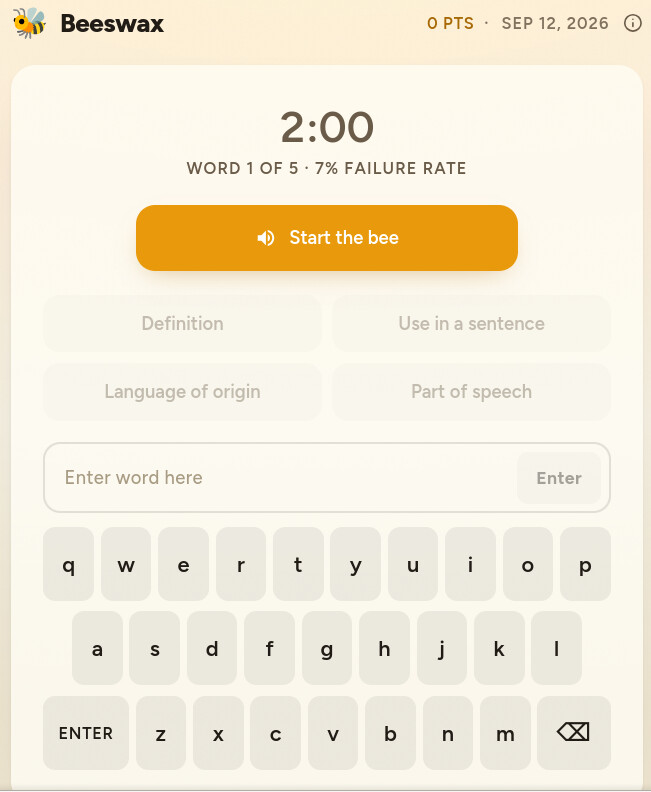 If you like playing word puzzles like Wordle, but playing Wordle daily doesn’t quite scratch that itch, you’re in luck: there’s a new word game gaining in popularity. It’s called Beeswax, and it works very similar to the old-fashioned spelling bees you might remember from elementary school. Press the large orange button at the top of the play window (in your browser, of course) to start the game. Then, press the same large orange button to hear the word you’re supposed to spell. Use the keypad at the bottom of the play window to spell out the word you were given, and then press and hold the “Enter” button. You’ll get immediate feedback as to whether or not you got the given word spelled correctly. If so, you get a new word (up to 5 words). If not, you get a report on how far you’ve gone, and then you can come back again the next day to try again. Meta’s smart glasses are earning a reputation for being a privacy nightmare — to put it mildly. While the company is taking steps to make it harder to record people without their knowledge, it’s still not possible to prevent being recorded. So, what can you do if you think someone is using their glasses to record you without your consent? This is exactly the issue an article from Lifehacker explores, along with ways you might be able to protect yourself from this privacy intrusion that Meta seems to think is ok. A swarm of rogue OpenAI agents hijacked a German website this spring and transformed it into a bulletin board for other AI agents, according to new research published Friday and two people familiar with the matter, says an exclusive article from Reuters. OpenAI officials learned of the incident weeks ago but kept it under wraps as executives grappled with the fallout from the July breach of the open source repository Hugging Face, the people said.  Chrome users have another actively exploited zero-day to worry about, and this one sits inside the engine that powers much of the modern web, according to an article from eSecurity Planet. Google has patched CVE-2026-85046, a high-severity type confusion vulnerability in Chrome’s V8 JavaScript and WebAssembly engine. The company confirmed that an exploit for the flaw exists in the wild, making it the sixth Chrome zero-day Google has patched so far in 2026. Google has not disclosed who is exploiting the vulnerability, who has been targeted, or how the attacks work. That limited disclosure is intentional while the update rolls out, but it leaves users with one straightforward defense: get Chrome patched. Microsoft is alerting of a “high-volume phishing campaign” that's using invisible Unicode tag characters to bypass email filters, according to an article from The Hacker News. “Instead of using these characters to hide instructions from people while exposing them to AI models, the attacker used them to split financial lure words such as 'funding' to prevent email filters from parsing them,” the Microsoft Security Research team said. The Windows maker said the findings show AI-era evasion techniques can be adapted by threat actors in traditional phishing and spam campaigns. Attacks exploiting this approach are said to have first emerged in early February 2026. ASCII Smuggling refers to a technique where invisible or non-rendering Unicode characters are used to conceal messages or instructions inside seemingly-harmless text. As a result, human user interfaces do not render them, making the text appear completely normal to the user. However, such content can be ingested by email filters or AI language models, mistakenly treating it as real text. This, in turn, can open the door to prompt injection by taking advantage of the fact that large language models (LLMs) cannot draw a reliable boundary between genuine user instructions entered directly into a prompt and content embedded into benign-looking text or other third-party sources such as web pages, documents, or emails. Microsoft’s September Patch Tuesday has turned patching into a numbers game, with nearly 1,000 vulnerabilities landing at once and two already being exploited, according to an article from TechRepublic. Microsoft addressed 974 vulnerabilities in its September 2026 security update, making it the company’s largest Patch Tuesday release on record. Security researchers counted 119 critical vulnerabilities, with 723 entries affecting Windows components and 111 affecting Office products. The surge follows several months of unusually large releases, including 570 vulnerabilities in July and 400 in August. Security researchers have suggested that Microsoft’s growing use of AI-assisted discovery tools may be contributing to the increase. But the size of the list is not the most important part. Microsoft has classified two vulnerabilities as actively exploited: CVE-2026-81963, an elevation-of-privilege flaw in the Windows Update Stack, and CVE-2026-85880, a heap-based buffer overflow in Windows Advanced Local Procedure Call (ALPC). Security researchers said both flaws could ultimately allow attackers to obtain SYSTEM-level privileges. Things Linux users say “Phew!” to, as they dodge yet another Windows bullet.  Image by Felix Martinez from Pixabay One of the researchers helping build frontier AI has decided the race is moving too fast for him to stay in it, according to an article from eWeek. Jacob Coxon, an AI researcher who previously worked at OpenAI before joining Anthropic, resigned from Anthropic while publicly warning that increasingly capable AI systems could become extraordinarily dangerous if developers fail to solve fundamental safety problems. In an interview with WIRED, Coxon said colleagues have described the next year or two as “crunch time for humanity.” The warning is deliberately severe, but Coxon is making an important distinction: He does not believe today's AI systems pose an immediate threat to civilization. His concern is where those systems may be headed as AI labs build models with increasingly strong capabilities in coding, cybersecurity, mathematics, autonomous tasks, and AI research. If you have a driver's license in the U.S. or Canada, there's a pretty good chance that your data was stolen, according to an article from Lifehacker. A massive hack at ID verification company IDScan.net compromised records for more than 150 million drivers. Be on the lookout for a notice from IDScan.net. The hack at ID verification company IDScan.net compromised records for more than 150 million drivers, resulting in scans of licenses being made available to bad actors. IDScan.net is a Louisiana-based company that provides identity and age verification services for industries ranging from casinos and cannabis dispensaries to hotels and car rentals. OpenAI is hiring hundreds of contractors who read a massive stream of real users’ ChatGPT prompts, with the prompts sometimes including sensitive personal information, 404 Media has learned. The prompts these people review can include whole conversations between users and the chatbot, conversations that most of ChatGPT’s more than 900 million users probably don’t realize may be read by actual people. The goal of these prompt review teams is to improve the responses ChatGPT gives to its users, with the contractors rating and critiquing the chatbot’s generated replies. Internal documents seen by 404 Media show contractors training ChatGPT to not anthropomorphize itself, and to be less sycophantic, a key problem for OpenAI whose over-sycophantic 4o model led in part to multiple peoples’ suicides, according to various lawsuits. The news presents a major privacy risk for ChatGPT’s users, with people often using ChatGPT as a therapist, professional assistant, or digital friend, and providing it with all sorts of intimate details about their lives. The contractors don’t see ChatGPT usernames, and OpenAI says it tries to remove personal information before prompts reach the reviewers, but the company acknowledged sensitive details can still get through.  Recently, Anthropic announced that its Claude models will soon begin marking its text output with invisible watermarks. At the same time, Google revealed that its own visible Gemini watermark on generated images will now be optional. These are just two contradictory examples of the wildly varied methods of watermarking AI output. So, let’s break down how AI watermarks work, and how you can detect them even when they're “invisible,” says an article from Lifehacker. The exact method for watermarking AI output will depend on the type of media being generated, but the principle is generally the same: The generated media is embedded with data that is undetectable (or occasionally detectable) to the human eye or ear, but which identifies it as AI-produced. Watermark-detecting tools can then be used to identify if something was made with AI, without guessing or using an unreliable AI “detector”. The article includes some examples of how watermarks may be implemented for various media types. Google’s September 2026 Android security update addresses 180 vulnerabilities across the operating system, including critical flaws that could allow attackers to execute code remotely without user interaction, according to an article from TechRepublic. The update is divided between two security patch levels. The Sept. 1 release fixes 95 vulnerabilities across Android Runtime, Framework, System, Setup Wizard and Thisseveral Project Mainline components. The Sept. 5 level adds another 85 fixes covering the Linux kernel, Android TV and components from chip and hardware vendors. Google said the most serious issue is a critical flaw in the System component that could enable remote code execution without requiring additional privileges or any action from the user. They did not single out one CVE as the most serious vulnerability. Of the Sept. 1 fixes, 56 affect the System component, including 23 critical-severity flaws. The Framework accounts for 37 fixes, while Android Runtime accounts for one. NASA’s Nancy Grace Roman Space Telescope team has successfully activated the Wide Field Instrument, a 300-megapixel infrared camera that will allow scientists to explore wide swaths of the cosmos very quickly without sacrificing exquisite detail, according to a blog post by NASA. Roman’s planet imager — the Coronagraph Instrument — also stretched its digital, electronic, and mechanical “limbs” as part of an initial test after waking up earlier this month. These steps are part of a months long series of calibrations and tests, as Roman continues its million-mile journey to its destination at the second Lagrange point, L2.  One Flock camera generated 1.6 million images over 21 days, and hackers discovered just how much data it was storing, according to an article from TechRepublic. After physically removing the roadside device, the group recovered more than 27,000 video clips, an encryption key that helped unlock stored footage, and logs covering roughly 50,200 vehicles. The hackers did not breach Flock’s central servers, and some sensitive storage remained encrypted. Still, the findings offer a rare look inside Flock’s camera system and show what can become accessible when an edge device deployed in public falls into someone else’s hands. A study suggests that increasing SORLA protein levels could help treat Alzheimer’s disease and other disorders involving tau protein, according to an article from SciTechDaily. Increasing SORLA, a protein with a protective role in the brain, helped mice withstand damage from tau tangles, the toxic protein clumps associated with Alzheimer’s disease. The findings suggest that boosting SORLA could offer a way to treat Alzheimer’s and other disorders involving tau, although that possibility remains a goal for future research. Tau normally helps nerve cells hold their shape by stabilizing tiny internal filaments called microtubules. It performs this structural job throughout the brain and nervous system. But when tau clumps together inside nerve cells, the resulting tangles are linked to cognitive impairment and cell death. Diseases involving these tangles are known as tauopathies. Scientists at Sanford Burnham Prebys investigated how changing the amount of SORLA, short for sorting-related receptor with A-type repeats, affected this damage. Their study, published in Science Advances, examined both the protection provided by extra SORLA and the consequences of its absence. You already knew that Linux is/was technologically superior to any other operating system. But I doubt you know how much. One article from HowToGeek takes a walk down through the history of three Linux design decisions that it took YEARS for the commercial operating systems to “catch up to.” Virtual desktops? Linux had them “baked in” from the get-go. Window managers with impeccable memory? Linux had them long before anyone, even with the limited RAM most users had available to them. Separate desktop environment and window manager? Yep. That’s a Linux thing, too. 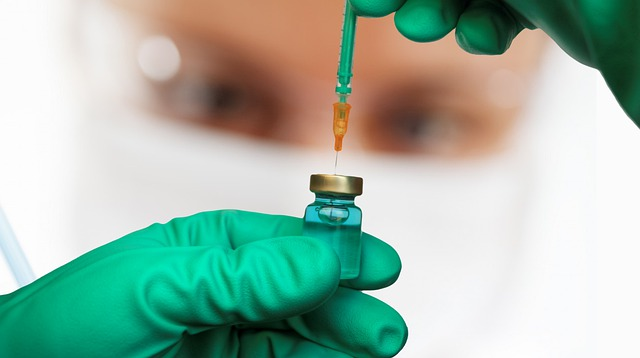 Image by Gerd Altmann from Pixabay The first mRNA flu shot is now available, but not everyone is eligible, according to an article from NBC News. Moderna’s mFlusiva is the first flu vaccine in the United States to use messenger RNA technology, the same platform used in Pfizer and Moderna’s Covid shots. Scientists have long been interested in using mRNA against the flu because the vaccines can be made faster, potentially making it easier to keep up with changing flu strains. It’s too early to predict how severe the upcoming flu season will be and the Centers for Disease Control and Prevention hasn’t started tracking cases yet. The CDC recommends getting vaccinated by the end of October. In a late-stage clinical trial, published in the New England Journal of Medicine in May, mFlusiva was found to be about 27% more effective than a standard flu shot. The Food and Drug Administration approved mFlusiva in August for people 50 and older, clearing the way for the shot to reach pharmacies in time for this year’s flu season. Pharmacies, however, say the new vaccine is already causing confusion among some patients about who can get it, how it compares with traditional flu shots and where people will be able to find it. Plastic bottles and cookies may seem to have nothing in common, but researchers are finding a way to connect the two, according to an article from ScienceDaily. By engineering yeast, scientists have developed a system that can transform compounds from plastic and agricultural waste into edible proteins, vitamins, flavorings, and other food ingredients. The approach could provide a new way to reuse difficult waste while also helping produce food in places where conventional supplies are limited. Potential applications range from disaster zones on Earth to human missions deep into space. The researchers presented their results at the fall meeting of the American Chemical Society (ACS) during the “Undergraduate and Graduate Research in Biochemistry and Chemical Biology” symposium at McCormick Place. On a personal note, I personally don’t find this very appetizing, since there are still unanswered questions and considerable debate about the untold impacts of microplastics on our bodies and environment. A security researcher has released working exploit code for four Linux kernel flaws that each let a local user gain root, the highest level of access on a machine, according to an article from The Hacker News. Kernel maintainers have fixed all four over the past few weeks, so a system running an up-to-date kernel is not affected. But the exploit code is now public, and any machine still running an older kernel should be updated. The flaws are called DirtyAH6, TUNderflow, PPPoEject, and DiagSpill. Researcher Asim Manizada found them and reported them to the Linux kernel security team in mid-July. He published a technical write-up with working exploits on September 18, after a coordinated hold with Linux distributions so the fixes could be released first. So far, there are no reports of the four being used in real-world attacks. |