
| Previous
Page |
PCLinuxOS
Magazine |
PCLinuxOS |
Article List |
Disclaimer |
Next Page |
The Online Safety Act |
|
by Agent Smith (Alessandro Ebersol)
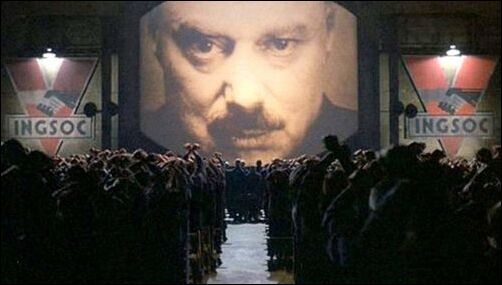 George Orwell must be rolling in his grave. England is implementing an internet access law called the Online Safety Act. It came into force in July 2025 and is considered one of the world's strictest laws for protecting children in the digital environment. The “official” narrative is that the Online Safety Act was created in response to a series of tragedies and growing concerns about the harmful impact of the internet on the lives of children and adolescents. It represents an ambitious attempt to make the digital environment safer, especially for young people. Well, that's what they say. But who is behind this law?
Now, the reasons for having laws to control internet access are, at first glance, very good and justified. After all, we want to protect children from accessing content that they should not be accessing. And when the two main parties in England unite in a common effort, there must be a very strong reason for it. And there is, but it is not any of those being propagated. Although England's two largest political forces are in favor of the online safety act, Nigel Farage of the Reform UK party strongly opposed the law, claiming that it threatens freedom of expression. Farage promised to repeal the legislation if his party wins the next election.  Nigel Farage Now, when the so-called right-wing populist extremist is the most reasonable voice in the room, something very strange is going on. Otherwise, why would England's two largest parties want to pass a law that will inevitably curtail the right to individual expression on the internet? Without delving too deeply into the English political environment, since that is not the scope of this article, it can be said that, since Tony Blair's Labour Party, the policies of Labour and the Conservatives have been almost identical, with rare differences: austerity, government downsizing, privatization, and revision of social welfare policies. In short, the two seem more like bridge partners than political adversaries. And with the new law, they may be trying to suppress Farage's party, which has grown impressively in recent years in England. But let's leave that aside, since we are interested in the effects of the law, not its causes.
As the saying above goes, good intentions can ruin everything, because what starts out as “protecting children” can end very badly. Let's see how the Online Safety Act works and why it was born already ineffective.
The Online Safety Act was prompted by a series of tragic incidents and concrete concerns about online safety, especially in relation to the protection of children and young people. Here are some of the key events and reasons that contributed to its creation:
All these cases caused an uproar in society, and, taking advantage of this public outcry, politicians created the Online Safety Act. However, before the OSA, Australia already had its own law, the Australian Online Safety Act, AOSA.
OSA operates aggressively on the side of online platforms, due to the identification requirements it forces them to implement and the massive regulation of the content displayed: Identification of Harmful Content: Platforms must identify and remove content that may be harmful, such as pornography, hate speech, and material that promotes self-harm or suicide. Content Classification: Platforms should classify content according to its potential harm and implement specific measures for each category. At OSA, one of the fundamental requirements is mandatory age verification. This must be implemented by digital platforms:
And all this to protect our “children.” But we will see below that these “good intentions” are fallacies, and that the target, despite being “children,” is actually the elderly, and that such new legal practices open up serious security loopholes.
At first glance, this may seem like a very good thing. After all, how many bots would disappear from the internet if only real people accessed it? And since these measures came into effect at the end of July, social media platforms Reddit, Bluesky, Discord, and X have introduced age checks to prevent children from viewing harmful content on their sites. Pornographic sites such as Pornhub and YouPorn have implemented age checks on their sites, now requiring users to submit a government-issued ID, provide an email address for the technology to analyze other online services where it has been used, or submit their information to a third-party provider for age verification. Sites such as Spotify are also requiring users to submit facial scans to third-party digital identity company Yoti in order to access content rated 18+. Unfortunately, circumventing biometric requirements is one of the easiest things to do today, and children and young people, who are digital natives (born with computers and smartphones), can easily bypass these requirements. And besides, what could go wrong with facial recognition?
Well, first, let's address facial recognition: Since OSA is being done very sloppily, there are several ways to circumvent its requirements. And kids already know this and are using computer games to circumvent facial recognition. People are already using selfies of Sam Porter Bridges (the protagonist of Death Stranding) to bypass Discord's age verification, thereby gaining authorized access without actually having their age verified and protecting the privacy of the user who used this feature. 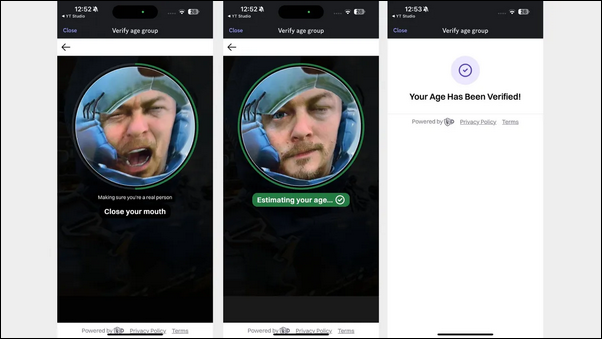 Taking selfies with Death Stranding In addition, VPNs also completely nullify the “effectiveness” of the law, since, in order to verify age, online services test the range of IP addresses that access the website and only apply the age test if the user's IP address comes from England. Thus, by changing the access IP to any other country outside the jurisdiction of this law, these digital locks become ineffective. But why not use facial recognition? After all, that would put an end to fakes on the internet. It would be great, except it wouldn't. Who has used facial recognition lately, and it went very wrong?  Tea App – A cautionary tale Recently, there was a massive leak of personal data from the website https://www.teaforwomen.com/, an online dating app exclusively for women based in the United States, with over four million users, which stood out for its ability to flag men as red flags, serving as a warning to other women interested in dating them. To sign up for the site and access the platform, you would need to be a woman, and, attention here: women must submit a selfie and an official ID to verify their identity. Once accepted, they are encouraged to share experiences, warn about risky situations, and connect with others for mutual support and protection. Of course, once again, we have “good intentions” that went very wrong, as the site has suffered at least two significant data breaches. The first breach, confirmed on July 25, 2025, involved the exposure of approximately 72,000 images, including selfies and identity documents, while a second breach revealed access to more than 1.1 million private messages. Now, with all the selfies, personal data, and everything else, such leaked data is delighting online scammers, who will have material for internet scams for years to come. In addition, the leaked data about the men on the website is generating public outcry among these men to sue the website for defamation and take it down permanently, as the comments made about the men on the platform border on harassment and defamation. That is why facial recognition should not be used on public platforms, as the risk of things going off the rails is too big.
No, we have already seen that this is not the case. But the point is to use very sensitive situations in the present day to generate public outcry that facilitates the passage of restrictive laws that will censor the internet. And for older people. Yes, young people, digital natives, know how to get around the restrictions imposed by laws, but older people do not.
Unfortunately, nowadays, we no longer have objective truth, but narratives. And at a time when news agencies report the facts to the whole world, smaller agencies simply replicate the information from agencies such as Reuters, AFP, Bloomberg, and the like, creating a cascade effect. Thus, with a handful of so-called “official” news sources around the world, it is very easy to create narratives that favor political interests. Now, the horizontal nature of the internet has favored the emergence of independent journalism, which has become a way to challenge official narratives. We must note that the OSA is not an isolated case, but at a time when contradictory narratives are suppressed, it is an effort to control expression on the global internet. In this effort to censor the internet, the following countries already have laws in place regarding internet access control: Australia, the United Kingdom, the European Union, and even the United States has several laws to “protect children,” but they are not federal. In Brazil, there is a movement, thanks to public outcry over YouTube videos by some notorious YouTubers, who are now being prosecuted. Well, the timing is strange, really strange, that, like a game of dominoes, in which each stone falls in sequence, now these “hidden forces” are putting pressure on Brazil
One of the objectives of the OSA is “Identification of Harmful Content: Platforms must identify and remove content that may be harmful, such as pornography, hate speech, and material that promotes self-harm or suicide.” However, these terms are so vague that they could mean anything. An opinion about a particular person or subject could be interpreted as hate speech, depending on how it is phrased. And the question remains: Who will judge what is or is not hate speech? What is or is not appropriate for children? Sure, there are things that are evidently harmful, but what about the rest ? What is appropriate for one, might not be for others.
Once again, the veiled objective of these laws is also to suppress fake news, but fake news cannot be combated with censorship. Fake news are combated with quality information, supported by reliable data and research, which can bring information closer to reality. When contradictory information is prevented, under the guise of combating fake news, only official fake news are accepted, without the right to contest them. This is not combating fake news, but rather imposing an official narrative and making it impossible to contest it.
Users in the United Kingdom have already made their dissatisfaction with the OSA clear: Within days of the age verification coming into effect, VPN apps became the most downloaded apps on Apple's App Store in the UK, and a petition calling for the repeal of the Online Safety Bill recently reached over 400,000 signatures. The internet must remain a place where all voices can be heard, free from discrimination or censorship by government agencies, and efforts must be made to truly make the internet safe for children, rather than using them as a pretext to impose Draconian laws whose objectives are far from what they appear to be.
I saved this cartoon by American cartoonist John Jonik a while ago. In its direct simplicity, it perfectly captures the moment we are living in. I think this cartoon was drawn around 2012 or 2015. 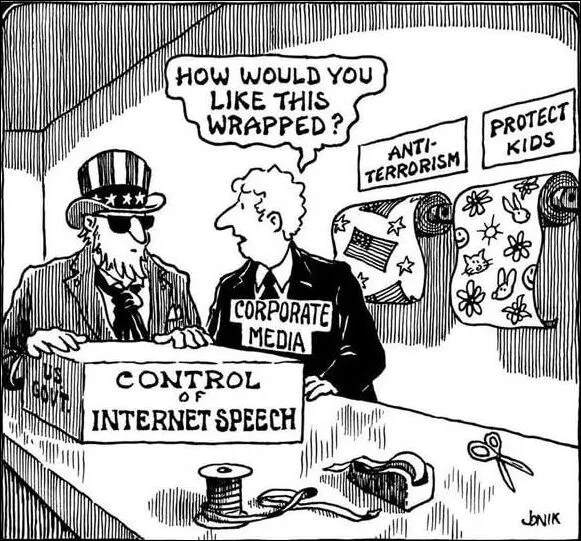 Tea App – A cautionary tale
|


